
In ultrasonic cable welding, quality is not determined by a single setting. The decisive factor is the interaction of amplitude, welding force, energy input, welding time, material, tool, and workpiece geometry. Therefore, anyone seeking to achieve consistent results in mass production should not only optimize individual parameters but also consider the entire joining process as a whole.
This article explains which factors are particularly important, how to determine a robust process window, and what companies should consider when conducting quality inspections, monitoring processes, and selecting an ultrasonic cable welding machine.
1. Why do process parameters affect weld quality?
Ultrasonic metal welding uses mechanical vibrations to create a material-bonded joint under defined contact conditions. The result depends on several interrelated factors. Therefore, a setting that works for a specific cable configuration is not automatically suitable for other conductor cross-sections, material combinations, or connection geometries.
For industrial evaluation, at least three aspects should be considered together: mechanical strength, electrical properties, and process reproducibility. The applicable test values and limit values must be determined based on the relevant product specifications and the requirements of the application.
2. An Overview of the Key Process Parameters
Amplitude: Precisely Adjusting Oscillatory Motion
Amplitude describes the oscillatory motion of the sonotrode. It influences the relative motion at the contact surface and thus the conditions under which the bond forms. An amplitude that is too low can limit bond formation. An amplitude that is too high can increase deformation and—depending on the material, strand structure, and tool—place stress on the joint or the material.
The appropriate setting should be determined using representative workpieces. In doing so, it is advisable not only to consider the machine-specified value, but also to evaluate the strength, electrical contact resistance, and geometry of the joint.
Welding Force: Checking Contact and Compression
The welding force ensures contact between the workpiece, the sonotrode, and the anvil. It affects the compaction of the strands and the mechanical conditions at the joint. Too little force can result in insufficient contact; too much force can alter the strand structure or increase the load on the tool.
It is important to note that the setpoint does not always correspond exactly to the force acting on the workpiece. Machine mechanics, tool condition, and workpiece positioning can all influence the result. Therefore, settings should be documented and their repeatability verified.
Welding Energy and Welding Time: Evaluating Them Together
Welding energy describes the amount of energy input, while welding time describes the duration of the process. These two factors are related but are not the same. A longer welding time does not automatically result in a better joint, since amplitude, force, material condition, and process dynamics also influence the energy input.
Whether time mode or energy mode is more suitable depends on the application and the machine configuration. The selection should be validated through testing and appropriate quality checks.
3. How can a robust process window be developed?
A process window encompasses the combinations of parameters that reliably achieve the required quality characteristics under specified manufacturing conditions. The goal is not merely a single successful welding operation, but a stable range that accounts for normal fluctuations in day-to-day production.
A structured approach typically involves the following steps:
- Define requirements: Document the material, conductor cross-section, strand configuration, connection type, and quality criteria.
- Select influencing factors: Determine relevant parameters and potential disturbances, such as tool condition or positioning.
- Planning experiments: Systematically vary parameters individually or in selected combinations.
- Check results: Evaluate mechanical, electrical, and geometric characteristics using appropriate methods.
- Ensure process reliability: Document appropriate settings and reevaluate them whenever changes are made to the material, tool, or application.
For complex applications, a multifactorial experimental design can help reveal interactions between the parameters. The specific experimental methodology should be appropriate for the development effort and the risks associated with the application.
4. What quality characteristics are relevant?
A single machine measurement is not sufficient to evaluate all the properties of a welded joint. For electrical cable connections, the following characteristics may be particularly relevant:
- Mechanical strength: Tensile, pull-off, or shear tests as specified for the joint and product.
- Electrical contact resistance: A measurement used to assess the quality of an electrical connection.
- Joint geometry: width, height, and compaction as indicators of material deformation.
- Process data: energy, time, force, amplitude, and other available signals for detecting deviations.
- Environmental and long-term conditions: for example, temperature fluctuations or vibrations, provided they are relevant to the application.
Test methods and limit values should be determined based on the specific application, customer requirements, and relevant technical specifications. A visually unobtrusive connection is not automatically sufficient from a mechanical or electrical standpoint.
5. Process Monitoring: Helpful, but Not a Substitute for Testing
Recording process data can help identify deviations early on and track manufacturing operations. Depending on the machine configuration, it is possible, for example, to document energy, welding time, force, and other signals. Data that can be clearly assigned to a workpiece, a set of parameters, or a production order is particularly useful.
Technical publications on quality control in ultrasonic metal welding examine various in-process signals, including sonotrode movement, power, thermal processes, and acoustic emission. However, this does not mean that every signal provides reliable information about quality for every cable connection.
A monitoring system should therefore first be validated using representative welds. Process signals can support ongoing quality control, but they do not automatically replace appropriate inspections of the workpiece.
6. Don't underestimate the materials, tools, and positioning
Material and Joint Geometry
Copper and aluminum differ in their material properties and surface conditions. With aluminum, the oxide layer is one factor that must be taken into account. In addition, the stranded structure, conductor cross-section, number of individual wires, and terminal geometry all influence the formation of the connection.
If the material, surface condition, or geometry changes, it is necessary to verify whether the previously validated settings are still appropriate. Clear workpiece documentation and representative material samples support a reliable process evaluation.
Tool Condition and Workpiece Positioning
The sonotrode and anvil transmit the vibrations and form the contact zone with the workpiece. Wear, damage, or contamination can alter the contact conditions. Defined inspection and maintenance intervals, as well as documented tool changes, facilitate fault analysis.
Positioning is also important: Shifts, uneven feeding, or misalignment can cause the joint to form under altered conditions. In automated systems, therefore, feeding, workpiece clamping, and alignment should be part of the process qualification.
7. What role do standards and testing requirements play?
DIN EN IEC 60352-9:2024-12 is a relevant normative reference for ultrasonic-welded, solder-free connections. The standard addresses general requirements, test methods, and practical guidelines for such connections. Whether and to what extent it applies to a specific cable or terminal connection must be determined by referring to the current edition of the standard and the relevant specification.
It is recommended that technical buyers and quality managers define test procedures, sample sizes, limit values, and acceptance criteria early on. This allows both the supplier and the customer to evaluate the results on a clear and transparent basis.
8. What should companies consider when selecting an ultrasonic cable welding machine?
The right machine depends on the workpiece, quality requirements, and production process. A wide adjustment range alone is not a sufficient selection criterion. Companies should consider the following points in particular:
- Application: Cable-to-cable, cable-to-terminal, or terminal-to-terminal connections, as well as material and conductor cross-sectional area.
- Process Control: Available Parameters, Welding Modes, Reproducibility, and Saving of Parameter Sets.
- Quality inspection: The ability to test representative workpieces and document the results based on agreed-upon criteria.
- Automation: Feeding, positioning, interfaces, and integration into existing production lines.
- Traceability: Assigning process data to workpieces or manufacturing operations, as needed.
- Service and Maintenance: Tool changes, cleaning, inspection, spare parts supply, and technical support.
Before making an investment decision, application-specific welding tests and verifiable test results should be agreed upon. The key factor is whether the system produces repeatable results under representative conditions.
9. How does MagnTek support industrial manufacturing processes?
MagnTek develops ultrasonic welding solutions for industrial applications, taking into account the specific workpieces, materials, and manufacturing requirements. Since applications vary in terms of geometry, material combinations, and production processes, technical consultation is essential to determine the appropriate system configuration.
In addition to selecting and customizing the technology, post-commissioning support plays an important role. When technical questions or unexpected problems arise, a clear error analysis, prompt feedback, and a reliable supply of replacement parts help keep downtime to a minimum.
With its KSS and KSG system concepts, MagnTek offers a variety of solutions for ultrasonic cable welding. The appropriate configuration should be determined based on the specific workpieces, quality criteria, and production conditions.
Would you like to improve your cable welding process? Talk to MagnTek about your application. Together, we can determine the relevant workpiece data, quality requirements, and appropriate inspection steps for the technical evaluation.
Magntek KS Series: Ultrasonic Welding for Various Conductor Cross-Sections
The Magntek KS Series includes four 20-kHz ultrasonic welding machines designed for various conductor cross-sections and joint types. Depending on the model, time- and energy-based control options, as well as various machine and tool configurations, are available.
KSK is designed for precise connections in applications involving smaller conductor cross-sections and terminal connections.
KSM It features a compact design and is suitable for, among other things, through nodes and end nodes.
KSS It is designed for medium-sized conductor cross-sections and features a vertical wedge geometry with feed on both sides.
KSG It is designed as a high-performance dual-channel machine for large conductor cross-sections and, depending on the application, can create conductor-to-conductor, conductor-to-terminal, and terminal-to-terminal connections.
For new applications, it is generally recommended to conduct a welding test using the actual conductors and connections. Based on this, the machine configuration, tooling, and process parameters can be determined collaboratively.
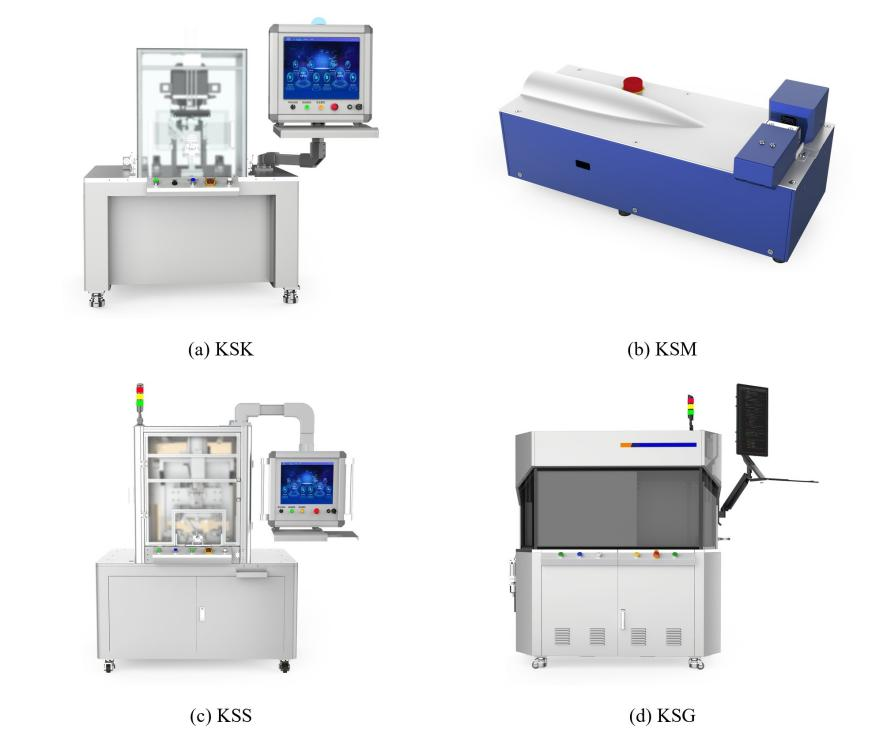
Figure: Magntek KS Series Ultrasonic Wire Harness Welding Machines
Frequently Asked Questions About Ultrasonic Cable Welding
Which process parameters are particularly important?
Key parameters include amplitude, welding force, energy, and welding time. The appropriate combination depends on the material, conductor cross-section, tool, and joint geometry.
Is a higher amplitude always better?
No. A higher amplitude can increase material deformation and place greater stress on the joint or the tool. The key factor is the verified quality characteristics.
Are welding energy and welding time the same thing?
No. The welding time refers to the duration of the process, while the welding energy refers to the amount of energy applied.
How is the quality of a cable weld assessed?
Depending on the application, mechanical tests, measurements of electrical contact resistance, the connection geometry, and process data are considered together.
Can process monitoring replace quality control?
No. Process data must be validated using appropriate tests and, on its own, does not guarantee an error-free connection.
When should parameters be reevaluated?
A re-evaluation may be necessary in the event of changes to the material, conductor cross-section, tooling, machine configuration, or key settings, as well as in the event of quality deviations.
Conclusion: Quality results from carefully calibrated parameters and systematic testing
Consistent quality in ultrasonic cable welding requires the coordinated interaction of amplitude, welding force, energy, and time. Equally important are the material, the condition of the tool, workpiece positioning, and stable manufacturing conditions. Systematic testing, appropriate quality inspections, and traceable process data create a solid foundation for mass production.
MagnTek helps companies evaluate their applications and select a suitable solution for ultrasonic cable welding. Technical suitability should be assessed using representative workpieces and clearly defined quality criteria.
Sources and References
- [1] Cheng, X. M. et al. (2022). Ultrasonic system and ultrasonic metal welding performance: A status review. Journal of Manufacturing Processes, 84, 1196–1216. https://doi.org/10.1016/j.jmapro.2022.10.067
- [2] Feng, M. et al. (2024). A review of quality monitoring for ultrasonic metal welding. Science and Technology of Welding and Joining, 29(1). https://doi.org/10.1177/02670836231215651
- [3] Design Strategies for Enhancing Strength and Toughness in Ultrasonic Welding of Dissimilar Metals: A Review (2025). Materials Today Communications, 42, 111502. https://doi.org/10.1016/j.mtcomm.2025.111502
- [4] DIN EN IEC 60352-9:2024-12.
- [5] An overview of the characteristics and performance of the ultrasonic welding process on different materials (2021). Materials Today: Proceedings. https://www.sciencedirect.com/science/article/pii/S2214785321058934
- [6] MagnTek – KSS Ultrasonic Cable Welding Machine: https://www.MagnTek.de/produkte/kss-ultraschall-kabelschweissmaschine/
- [7] MagnTek – KSG Ultrasonic Cable Welding Machine: https://www.MagnTek.de/produkte/ksg-ultraschall-kabelschweissmaschine/